
A $150K Paycheck Needs a $479K Business. Here's How to Find Your Number.
Oct 24, 2026
Welcome to Make Bank. I'm a CPA, MBA and founder helping other founders think bigger about their money. I share the financial intelligence you need to scale from six to eight figures, build real wealth, and create a business that gives you options.
Do you know the real number that tells you when you can leave your W-2? Today, I'll walk you through how to find it in three simple steps.
Once you know that runway number, the decision to exit gets a lot quieter in your brain. You can open your business bank app after a good month and know exactly what it means. You can tell your spouse, your partner or your own busy mind what has to be financially true before you hand in your notice. And you get to make one of the biggest money decisions of your career from a place of clarity.
Why is this here in Make Bank. when the newsletter is about scaling businesses from six-to-eight figures?
Glad you asked.
From the math in the title, someone who needs to bring in $150,000 annually might have to have a business that generates nearly half-a-million dollars in top-line revenue. In other words, a business that pays you like your day job did is almost certainly a six-figure business already.
Those companies don't just pop up overnight. And for the founders who are out there (and I know you're out there) working both a W-2 and scaling a business, these next few editions of Make Bank. apply to you and the cohort of owners who are sitting in the six-figure rev cycle trying to hit seven or even eight.
These short, powerful steps will help you find the one take-home number, one top-line revenue number, and build a plan that holds up when business gets busy, messy or both.
Unfortunately, nobody hands you this math with your business license
If you haven't run these numbers yet, you are in very good company. The reasons are completely understandable:
- Your salary is the only income number you've ever had. Of course it feels like the natural goal.
- Revenue and income look alike from a distance. They only separate once you see what the business pays for first.
- Your employer has been quietly covering a lot. Health insurance, a retirement match, expense reimbursements and tax withholding all happen in the background, so they're easy to overlook.
- Spreadsheets aren't everyone's happy place. You can be brilliant at your business and still not have a working knowledge of Excel.
- A big unknown can feel easier to leave alone. Naming it is exactly what turns it into a plan.
The good news is there are three steps to get you to a number you can trust
No accounting jargon. No corporate bloat. No judgment if you haven't opened your bank app since Tuesday. Here's how to get back on track to finding your runway number, step by step.
Step 1: Build your Runway Number from your expenses
This comes first, since every other calculation rests on it.
Your Runway Number is the minimum your business needs to pay you so you can cover your bills and responsibilities with confidence, no W-2 required.
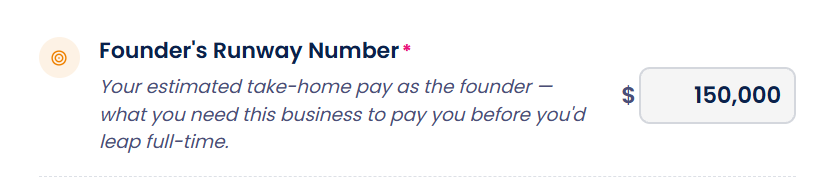
Here's the freeing part: your salary isn't that number. Two people can each earn $80,000 and have very different needs. One may live comfortably on $60,000. The other may need $100,000 once she replaces employer-paid benefits and retirement contributions. Your number is yours alone.
To build it, add up three things:
- Monthly household expenses. Mortgage or rent, utilities, groceries, transportation, childcare, debt payments and insurance.
- Benefits you'll replace. Health insurance and any retirement match your employer provides today.
- A safety buffer. Life happens, and a little cushion keeps a slow month from feeling like a crisis.
Pull your real numbers from your bank account and recent statements. Exact figures today mean confident decisions later. Leave taxes out at this stage. Your business will cover the taxes on its profits, and Step 2 handles that for you.
Keep this one phrase in your head while you work:
Income is the outcome. Your expenses tell you what the business has to support.
Step 2: Work backwards from your Runway Number to your revenue goal
This is the step that changes how you see your business, so take it slowly. It's natural to assume a business that pays you $100,000 needs $100,000 in sales. Once you see everything the business covers first, the real number makes sense, and it becomes something you can plan for.
Three things come out of revenue before you get paid:
- Fixed costs stay about the same no matter how much you sell. Think software subscriptions, business insurance and bookkeeping fees.
- Variable costs rise with every sale. Think payment processing fees, materials and per-project contractors. A quick test: "If I sell more, will this expense increase?" If the answer is yes, it's variable.
- A tax reserve covers income tax and self-employment tax, which you'll now set aside yourself.
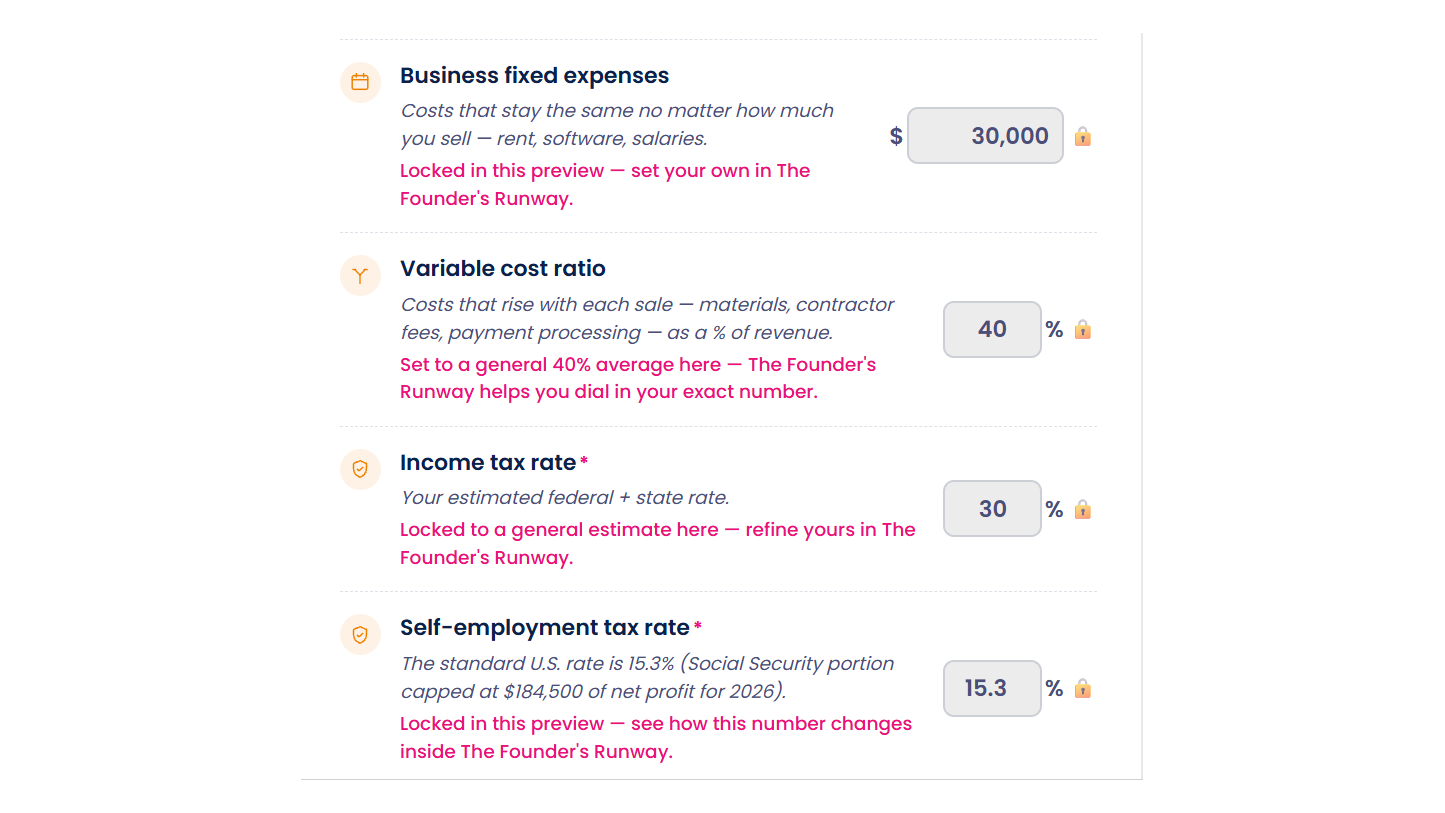
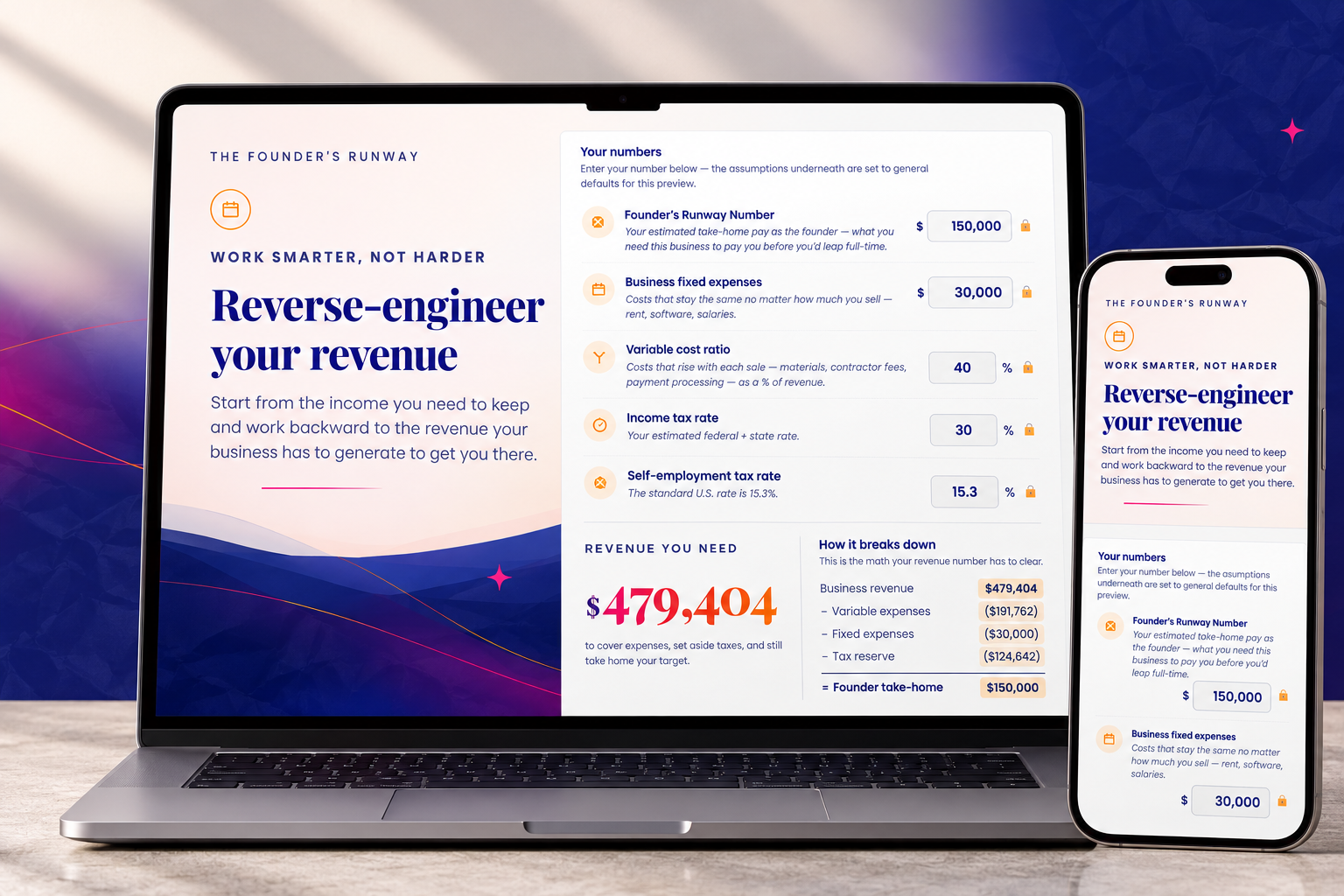
Not interested in reading what looks like a math problem from high school Algebra 2 class?! Agreed. If you're like me and want a more visual tool to use, I built this free Revenue Goal Planner so that you can play around with the numbers. Here's what it looks like:
Now, to continue the article for those who do love a good math problem...
Here's what it looks like in practice. The Revenue Goal Planner I built opens with an example Runway Number of $150,000 and a set of general assumptions: $30,000 in fixed costs, variable costs at 40% of revenue, a 30% income tax rate and the 15.3% self-employment tax rate. The revenue goal it returns is about $479,400.
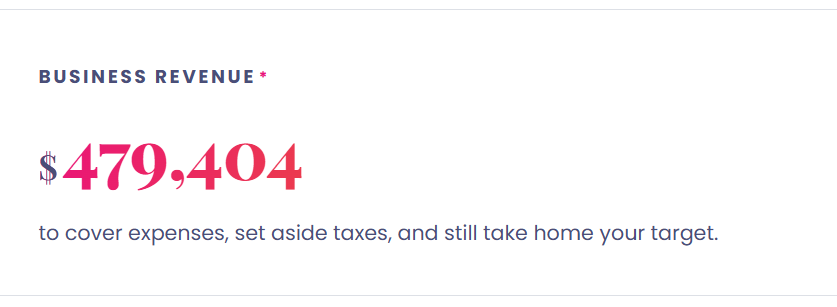
Here's where that money goes:
- Business revenue: $479,400
- Variable expenses: -$191,800
- Fixed expenses: -$30,000
- Tax reserve: -$107,600
- Founder take-home: $150,000
That revenue is a little more than three times the take-home paycheck, and now you can see exactly where every dollar goes. Each one has a job, and your take-home is protected once the business has covered its own expenses.
So, set your take-home pay and let the math do the heavy lifting. Enter your own Runway Number in the planner and it works backwards in seconds. Think of the result as a destination in your GPS: it shows you where you're headed and roughly how far. Your costs and tax picture will be your own, and a business with lower variable costs will often see a lower number.
Step 3: Pressure-test the number against your calendar and a slower year
Here's the light at the end of the tunnel: once your number passes this step, you get to stop wondering and start deciding.
Start with a capacity check tool that we use inside The Founder's Runway. Using the example above, say you charge $2,000 per client and each client takes about 10 hours from start-to-finish.
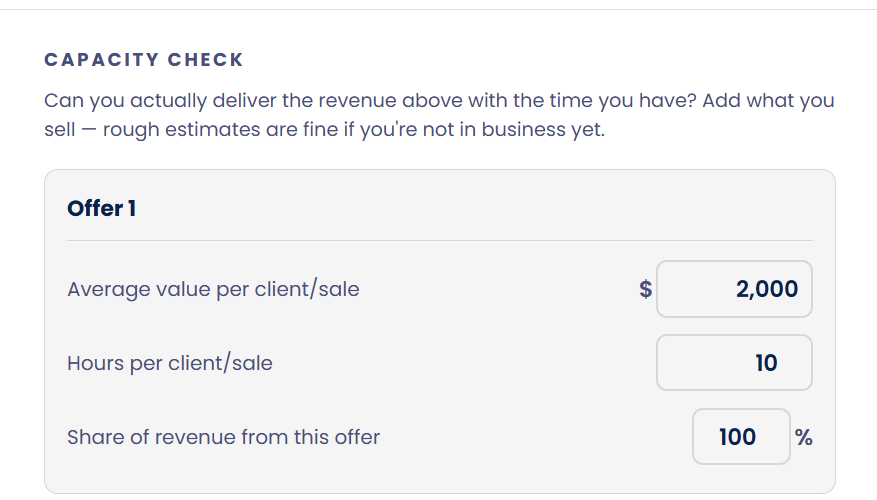
And let's say you want to have work-life balance, so you only want to work 30 hours a week. Well, a $479,400 revenue goal means your business might need about 240 clients which then translates to roughly 2,400 hours a year. But, thirty hours a week gives you only 1,560 hours a year, which is 156 clients...
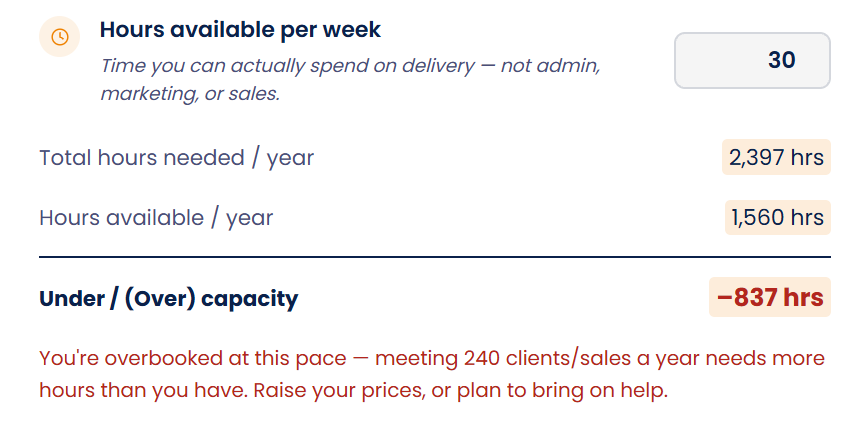
This is called a capacity constraint.
That gap is useful information, and it comes with options. You could:
- raise your prices
- make each client take less of your time
- bring in help
- give yourself a little longer before you leave
Every one of those options is a smart move, and the numbers show you which one fits.
Then run three scenarios: expected, best case and worst case.
Ask what happens if revenue lands 20% under plan. In this example, that leaves about $200,000 in profit before taxes, against the roughly $257,600 it takes to fund a $150,000 take-home. Spotting that at your desk gives you time to build a cushion.
If your business supports your Runway Number in only the best case, you've learned exactly where to strengthen your plan. Write a few decision rules to guide you, such as:
"I will leave my W-2 once I have six months of personal and business expenses saved."
All three steps ladder up to one thing: a leap you can feel good about. When you hand in your two weeks' notice, you'll know your business has earned the opportunity to support your life.
The Recap
The goal is knowing when your business is ready to replace your paycheck. The playbook:
- Build your Runway Number from your expenses.
- Work backwards to the revenue that funds it, after costs and taxes.
- Check that revenue against your hours, then against a slower year.
Plot twist
I opened this edition by asking you to find the real number behind your exit. Here's the surprise on the other side of the math: you may need less than you earn today, and your business may need to earn more than three times that. Both could be true at once, and both could be good news. Your needs may be smaller than you thought, and the business that meets them is a real company with room to grow.
When you're ready, here's how I can help you
Ready to see your own number? Go on, I dare you. Get the free Revenue Goal Planner here, enter your Runway Number, and watch it work backwards to your revenue goal.
Then subscribe to Make Bank. Every other week, I send the financial intelligence founders need to build a business that pays them well. Hit subscribe so the next edition lands in your inbox.
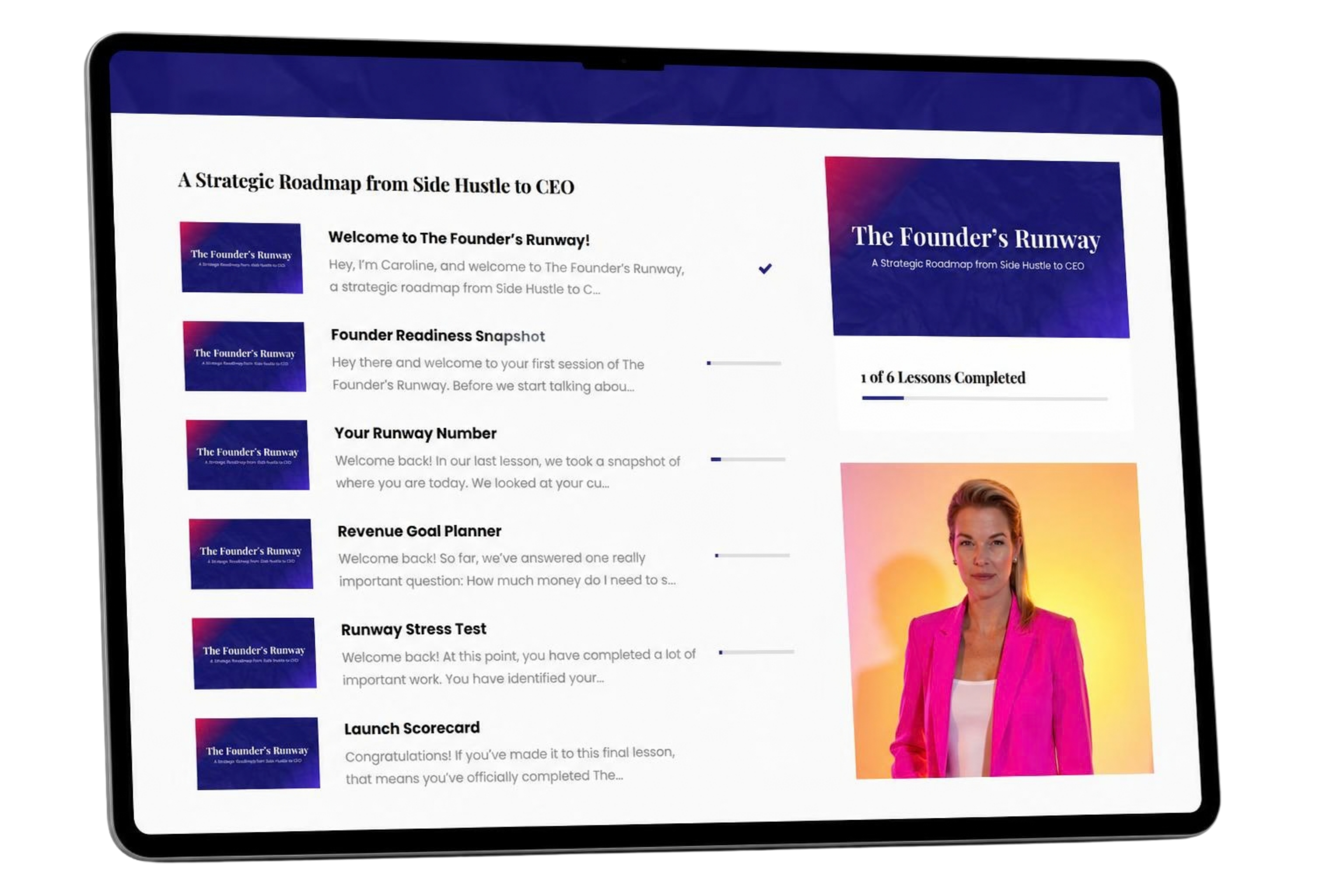
And if you want help with all three steps, I also have a CFO-backed framework called The Founder's Runway. It's designed to help founders turn "can I afford to quit my day job?" into a number and a plan in one focused hour. Learn more about The Founder's Runway here.

About the Author
Caroline Beasley is a CPA, MBA, and Big 4/Big 8-trained accountant who works as a strategic CFO for founders scaling past $1M in revenue. She helps business owners trade gut feel for real financial clarity by showing them true profit margins, protecting cash flow, and building a dashboard that shows in seconds whether the month is on track.
She's especially passionate about helping women founders and creators access the CFO-level thinking that fuels sustainable growth. A military spouse and IRONMAN triathlete, she believes lasting success comes from discipline and boundaries, not burnout.
Want the truth about your numbers in your inbox? Follow Caroline on LinkedIn and subscribe to her newsletter, Make Bank. (or keep scrolling to sign up below).